 Alibaba
 Ant Group
 Baidu
Baidu
 ByteDance
 Cambricon
 DeepSeek
 Huawei
 iFlyTek
 MiniMax
 Moonshot AI
 Pony.ai
 StepFun
 Tencent
 Doubao (豆包)
344.9M MAU
Doubao (豆包)
344.9M MAU
 Xiaohongshu (小红书)
300M+ MAU
Qwen (千问)
165.6M MAU
DeepSeek
127.1M MAU
Tencent Yuanbao (元宝)
57.4M MAU
Xiaohongshu (小红书)
300M+ MAU
Qwen (千问)
165.6M MAU
DeepSeek
127.1M MAU
Tencent Yuanbao (元宝)
57.4M MAU
 Alibaba
10
DeepSeek
9
Alibaba
10
DeepSeek
9
 CXMT
3
ByteDance
3
CXMT
3
ByteDance
3


7 月 16 日晚,众擎 URKL 全球人形机器人自由格斗联赛在深圳开打。比赛中,一台机器人被对手踢掉了头,但它没有停下来,依靠躯干里的核心系统继续出拳,硬是把比赛打完了。
这场比赛采用 1V1、5 回合赛制,每回合 5 分钟。最终,黑色机甲「斗牛士」以 3:2 击败白色机甲「雄鹰」。到场观赛的动作演员甄子丹表示,自己过去只在科幻电影里见过机器人格斗,这次近距离观看真实对决,感觉「很震撼」。
URKL 吸引了来自 10 余个国家的 200 多支队伍报名,最终 32 支队伍晋级。总决赛预计在今年 12 月至明年 1 月举行,奖金池为 1400 万元,冠军还将获得价值约 1000 万元的纯金腰带或等值奖金。
周末看什么|《镜的第三乐章》

《镜的第三乐章》由克里斯蒂安·佩措尔德执导、编剧,葆拉·贝尔、巴尔巴拉·奥尔主演,片长 86 分钟,2025 年入围戛纳电影节导演双周单元。
影片讲述钢琴学生劳拉在车祸中幸存、男友身亡后,被目击者贝蒂带回家照料。她逐渐融入这个家庭,但平静生活很快被创伤、悲痛和身份投射打破。影片借拉威尔《镜》第三乐章《海上孤舟》,讨论失去之后的情感依附、家庭关系与自我修复。
评分方面,豆瓣为 7.3 分,基于 7,171 人评价;MUBI 为 7.4 / 10,基于 1,719 人评分;烂番茄影评人新鲜度为 95%。影片整体以克制、暧昧的心理叙事见长,但缓慢节奏和开放式表达可能令偏好强情节的观众感到不足。
买书不读指南|《天书奇谭》

清华大学建筑史学者贾珺的《天书奇谭》由生活·读书·新知三联书店出版,全书分上下两卷、18 篇文章,配有约 278 幅图片。
本书将中西建筑史经典与金庸小说中的武学体系对应起来:维特鲁威的《建筑十书》被比作融合《易筋经》和少林七十二绝技的「少林宗师」;李诫编修的《营造法式》则被比作地位崇高、内容深奥的《九阴真经》。
每篇文章都采用「虚实相生、双璧对照」的写法:一方面介绍真实存在的建筑典籍、建筑流派与理论概念,另一方面借助金庸作品中的武学设定进行类比。这种写法并非单纯追求趣味,而是试图通过读者已有的文化经验,降低建筑专业知识的阅读门槛。
游戏推荐|《加利宅邸悬案》

《加利宅邸悬案》改编自广受好评的文字游戏《Type Help》,并由《鲁特里一家死了》的团队重新打造,加入全插图视觉小说演出、专业配音、3D 记忆交互界面、原创配乐,以及新的内容、谜题和分支路线。
游戏故事发生于 1936 年 3 月 7 日。当地人来到一座荒废多年的加利宅邸,在屋内发现了严重暴行留下的现场。警方虽介入调查并清理了犯罪现场,但始终未能还原那个夜晚发生的事情。
多年后,玩家获得一台能够聆听「过去回响」的神秘装置,需要借助其中残留的记忆线索,逐步拼接人物关系、事件经过与案件真相。
目前,游戏在 Steam 收获「好评如潮」评价,697 篇用户评测中有 96% 给出好评;页面显示的首发优惠价为 ¥ 68.40,优惠截至 2026 年 7 月 22 日。
#欢迎关注爱范儿官方微信公众号:爱范儿(微信号:ifanr),更多精彩内容第一时间为您奉上。
]]>

 Alibaba
 MeituanAlibabaAnt GroupTencentXiaomiXiaomiAlibabaStepFun
 Shengshu TechnologyDeepSeekAnt Group
 ModelBestXiaomiXiaomiXiaomiiFlyTekAnt GroupAlibabaAnt GroupTencentAlibaba
 Zhipu AI (Z.ai)DeepSeek
 SenseTimeAlibabaZhipu AI (Z.ai)MiniMaxDeepSeekAlibabaAlibabaAnt GroupByteDanceAlibabaXiaomiAlibabaRedNote (Xiaohongshu)ByteDanceMiniMaxDeepSeekSenseTimeHuaweiAlibabaAnt GroupAlibabaTencentTencentTencentSenseTime
 Kunlun TechKunlun TechModelBestModelBest
 WeRide
 UnisoundMoonshot AIAnt GroupAnt GroupAlibabaAnt GroupAnt GroupAnt GroupTencentShengshu TechnologyZhipu AI (Z.ai)MiniMaxMoonshot AIStepFunMeituan
 XPengAlibabaBaidu
 Baichuan AIModelBestModelBestZhipu AI (Z.ai)MiniMaxMoonshot AIDeepSeekDeepSeekBaiduAnt GroupAnt GroupAnt GroupTencentXiaomi
 AGIBotXiaomiUnitree RoboticsKunlun TechKunlun TechKunlun TechByteDanceByteDanceByteDanceAlibabaAlibabaZhipu AI (Z.ai)MiniMaxBaiduAnt GroupAnt GroupAnt GroupAnt GroupBaichuan AI
 JD.comMoonshot AIDeepSeekTencentMeituan
 AIsphereSenseTime
 LimX DynamicsDeepSeek
 KuaishouXiaomiAIsphereTencentiFlyTekMiniMax
 Infinigence AIAlibabaModelBestMoonshot AIMiniMaxMiniMaxShengshu TechnologyHuaweiRedNote (Xiaohongshu)DeepSeekKuaishouKuaishouSenseTimeKunlun Tech
 Qihoo 360BaiduBaiduStepFunBaichuan AIModelBestKuaishouInfinigence AIKunlun TechQihoo 360Baichuan AIBaichuan AI
 01.AI01.AIiFlyTekStepFunStepFun01.AIQihoo 36001.AI01.AIKunlun TechBaichuan AIJD.comMeituanMeituanMeituanWeRidePony.aiUnisoundUnisoundUnisoundUnisound
23 public · 20 private
12 AI-native cos








The essential tracker for China's AI ecosystem
One place to follow every major model release, funding round, product launch, and breakthrough from China's AI ecosystem.

China AI Index is a research project built and maintained by Tony Peng — a long-time observer of the AI industry with a background in journalism and communications — with the assistance of AI (Claude Code, Qoder, and Z Code). Tony is also the writer behind Recode China AI, a newsletter tracking the latest advances and news stories in intelligent technologies.
It exists to give English-speaking researchers, investors, journalists, and developers a structured reference for China's AI ecosystem — most authoritative information is published in Chinese, and this site translates and synthesizes it.
All pricing, benchmark scores, funding amounts, and valuations are sourced from public company announcements, tech media reporting, and developer documentation. They are provided for informational purposes only and may be approximate or subject to change.
Stock prices shown are approximate historical ranges — not real-time quotes. Always verify with a live financial data source before making investment decisions. Benchmark scores reflect results at the time of model release and may not account for subsequent updates.
This database is independently maintained and has no affiliation with any of the companies listed. Information is updated manually on a best-effort basis.
Extends the August deployment-side guide upstream to agent system development. Together the two documents suggest TC260 is building a build-and-run pair for agents ahead of any binding rule.
View Official Text ↗Four documents released together, the start of a general-plus-sector series. The General Principles apply across all industries; the other three give sector-specific security practice guidance for education, health, and broadcasting/online audiovisual. Drafting units include CESI, the NRTA research academy, NHC and MOE information centers.
View Official Text ↗China's Chip Ecosystem
Domestic AI accelerators, large-scale training clusters, and memory chips — tracking the hardware layer behind China's AI buildout.
| Company | Chip | Role | Peak Compute | Memory Tech | Capacity | Bandwidth | Interconnect Bandwidth |
TDP | Process | Status | Highlights |
|---|---|---|---|---|---|---|---|---|---|---|---|
| Huawei ↗ | Ascend 910B |
Training |
256 TFLOPS
BF16
|
HBM2e | 64 GB | 2.0 TB/s |
392 GB/s
HCCS 3.0
|
400 W | SMIC N+2 | Production | Most-deployed domestic training chip. Used at Alibaba, ByteDance, Baidu, and Tencent. |
| Huawei ↗ | Ascend 910C |
Training |
800 TFLOPS
FP16
|
HBM2e | 96 GB | 4.0 TB/s |
800 GB/s
HCCS
|
900 W | SMIC N+2 | Production | Dual-die upgrade to 910B. Powers the Atlas 900 A3 SuperPoD (300 PFLOPS). |
| 🔒 18 more accelerators — paid subscribers only | |||||||||||
| Cluster / Supernode | Operator | Chip | Chip Count | Total Compute | Interconnect Fabric | Notes |
|---|---|---|---|---|---|---|
Atlas 900 A3 SuperPoD (CloudMatrix 384) |
Huawei Cloud | Ascend 910C | 384 |
300 PFLOPS
FP16
|
All-optical (OXC) | Huawei's current-generation supernode. Uses optical circuit switching (OXC) for low-latency inter-chip communication. Announced April 2025 as a full-stack domestic alternative to Nvidia GB200 NVL72. |
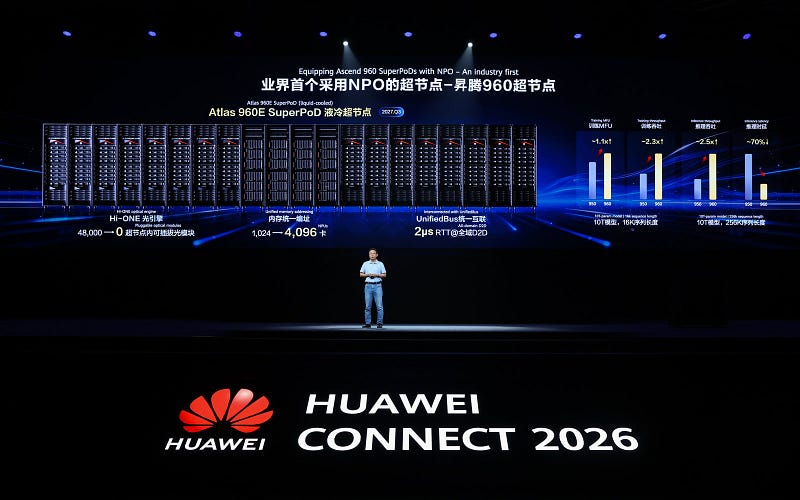
Atlas 950 SuperPoD |
Huawei Cloud | Ascend 950 | 8,192 |
8 EFLOPS
FP8
|
16.3 PB/s aggregate | Next-generation supernode targeting 2026 delivery. 1,152 TB total memory. Full liquid cooling. Footprint larger than two basketball courts. Would represent a major leap in domestic training capacity if delivered at spec. |
| 🔒 3 more clusters — paid subscribers only | ||||||
| Company | Product | Type | Capacity | Bandwidth | Process | Status | Notes |
|---|---|---|---|---|---|---|---|
| CXMT ↗ | DDR5 |
DDR | 16–32 Gb dies | ~6400 MT/s | ~16nm (G4) | Production | CXMT's latest-generation DDR5, unveiled Nov 2025 — its push into the high-end DRAM market against Samsung, SK Hynix, and Micron. |
| CXMT ↗ | LPDDR5X |
LPDDR | Mobile | ~8533 MT/s | ~16nm | Production | Low-power mobile DRAM for smartphones and edge/AI devices. |
| 🔒 2 more memory chips — paid subscribers only | |||||||